
01Review
See the system clearly.
We map the work—who owns what, where it hands off, which tools are involved, and where it gets stuck—before deciding what to change.
About Sato Systems
Sato Systems builds the systems a growing business runs on. We review how work actually moves, build the systems that are missing, and support the people who use them.

Why I founded Sato
For more than a decade, I’ve talked with leaders at small, midsize, and large companies about the software they use to run their work. The details changed. The problem usually didn’t: too many steps to get important work done, not enough visibility into where that work stood, or both.
The tools were rarely the whole problem. Work moved through inboxes, spreadsheets, software, meetings, and people. And it wasn’t always clear who owned it or what happened next. That’s when important things started to slip—follow-ups, customer work, decisions, and time.
What stayed with me was this: the people were capable. The work had simply become harder to see and coordinate. More software wasn’t always the answer. Owners already had plenty of tools. What they often lacked was practical help connecting those tools to the way their business actually worked.
That gap was especially clear for growing businesses without enterprise budgets or large internal systems teams. They needed a system that could keep the right information together, automate the parts that made sense, make ownership visible, and keep the team trained and supported as the business changed.
That’s why I founded Sato Systems.
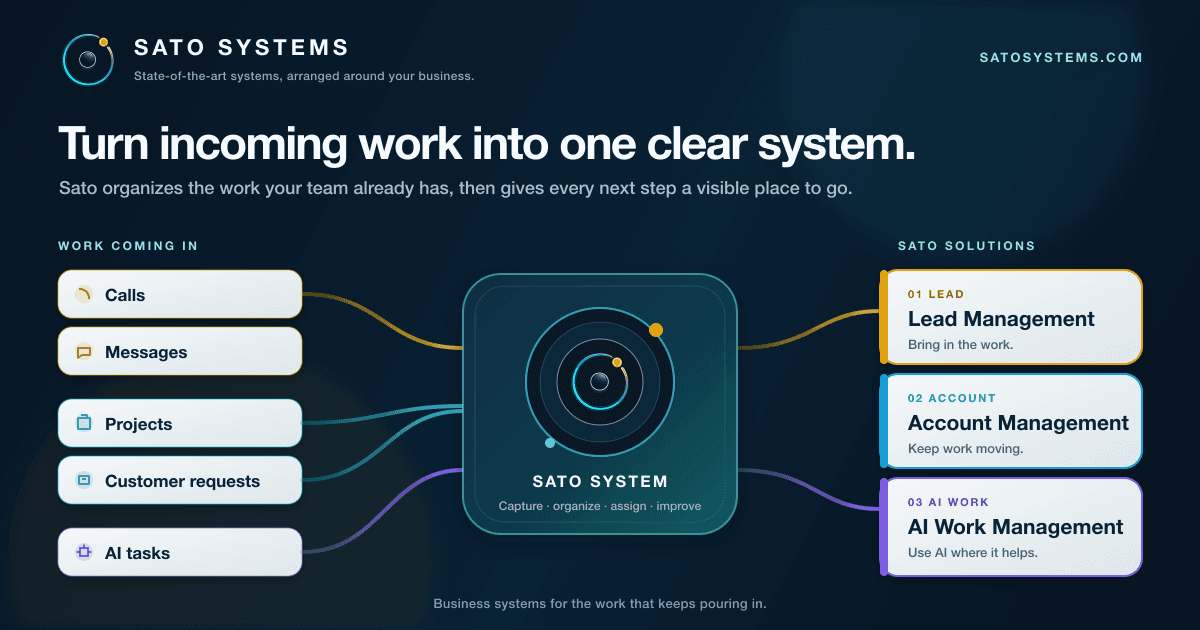
Sato Systems builds the systems a growing business runs on. At Sato, we review how leads, customer work, projects, decisions, follow-ups, and AI-assisted tasks move across your people and your tools. Then we build what’s missing and stay to support the system and the people using it.
The goal is simple: make important work easier to see, own, finish, and improve—so the business gets easier to run as it grows.
How Sato works
A clear path. Start where your business needs help most.
01Review
We map the work—who owns what, where it hands off, which tools are involved, and where it gets stuck—before deciding what to change.
02Build
We turn the agreed plan into a practical system your team can actually use, not another stack that adds more steps.
03Support
We maintain, review, and improve the system as your business changes, so it keeps doing the job it was built to do.
Operating principles
Experience brought to Sato
The work below is mine, from roles I held before I started Sato. I’m not calling it Sato client work, because it isn’t.
Explore verified resultsOperating philosophy
I keep prior-role experience, client work, credentials, and testimonials separate, so every example on this site says exactly what it is.
Founder
I founded Sato Systems to bring workflow design, practical automation, and responsible AI implementation together in one place. The goal was never more software. It’s a clearer way to run the business you already have.
Connect on LinkedInStart with the part that feels unreliable